
Finance transformation is a phrase built for boardrooms at banks and energy majors. It shouldn’t be. The global consultancies have spent a decade selling it to enterprises at $250,000 an engagement, wrapped in language most mid-market owners would never use about their own business.
Strip the vocabulary away and what’s underneath is straightforward: moving your finance function from recording what already happened to shaping what happens next. Every capability in that enterprise playbook — rolling forecasts, scenario models, automated close, real-time reporting, AI-assisted analysis — is now available to a business doing $5M or $50M. The technology commoditized. The expertise went fractional.
What hasn’t changed is that most mid-market companies don’t know this is available to them, because nobody sells it in language they recognize. This guide translates it.
The Translation: Enterprise Jargon, Plain English
Here’s what the consultancy vocabulary actually describes once you scale it to a business your size.
| What they call it | What it means at $10M |
|---|---|
| Operating model redesign | Deciding who does what, and writing it down so it survives a resignation |
| Performance management capability | A monthly report your leadership team actually reads and acts on |
| Enterprise planning platform | A forecast that updates from actuals instead of being rebuilt each quarter |
| Intelligent process automation | Bank feeds, coding rules, and approval workflows you already pay for |
| Finance as a business partner | Someone senior in the room when you decide to hire, price, or borrow |
| Transformation roadmap | An ordered list of fixes, hardest-value-first, with dates against them |
None of that requires SAP, Anaplan, or a seven-figure budget. It requires someone who has done it before, working inside the systems you already own.
Four Stages of Finance Maturity
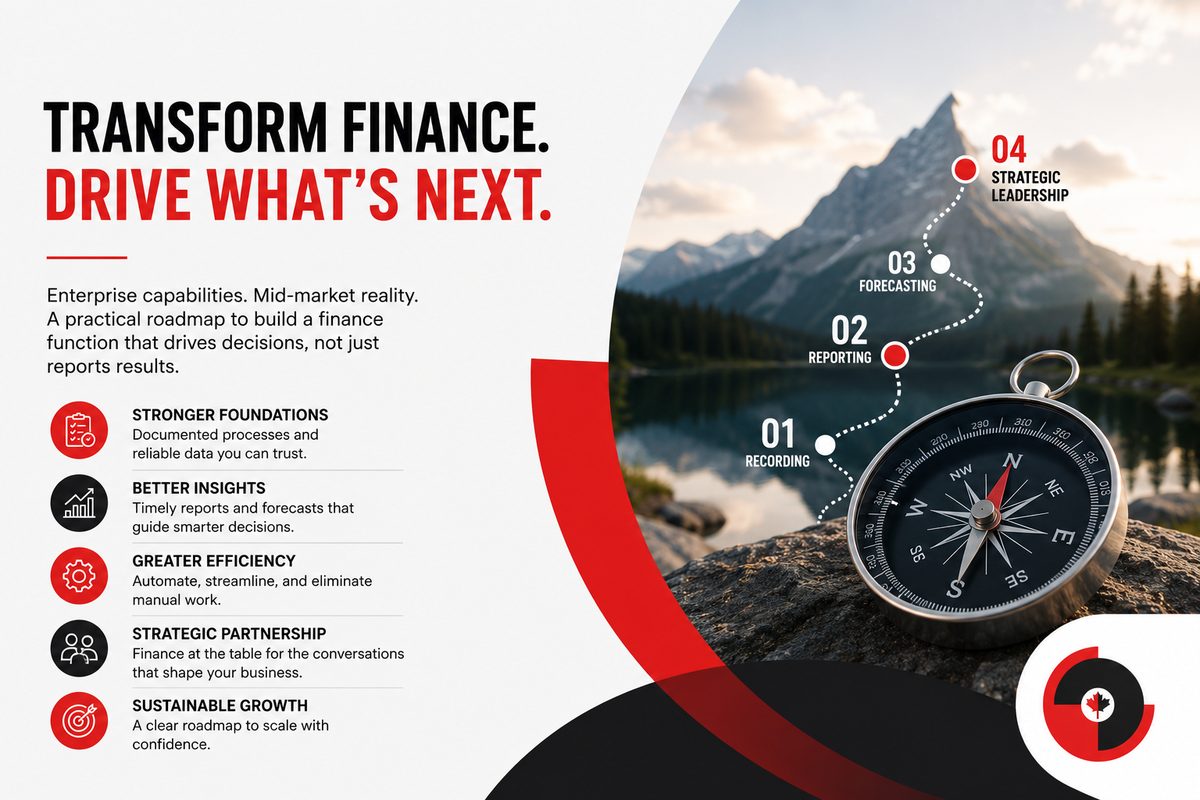
Transformation isn’t one leap. It’s a progression, and almost every Canadian business we meet sits somewhere on this ladder. Find yourself honestly — the stage you’re at determines what to fix first.
STAGE 01 · RECORDING
The books get done, eventually
A bookkeeper handles transactions. Statements arrive weeks late and nobody fully trusts them. Decisions get made on instinct and the bank balance.
You’re here if: you check the bank account to decide whether you can afford something.
STAGE 02 · REPORTING
The numbers are reliable but backward-looking
Close is disciplined, statements are accurate, an accountant reviews the work. But everything describes the past. There’s no forecast, and nobody is asking why the numbers moved.
You’re here if: your reports are correct and nobody does anything with them.
STAGE 03 · FORECASTING
Finance starts pointing forward
Rolling cash flow and budget forecasts exist and get updated. Variances are investigated, not just noted. Leadership sees what’s coming with enough lead time to change it.
You’re here if: you can answer “what does cash look like in ninety days” without building a spreadsheet.
STAGE 04 · PARTNERING
Finance shapes the decision, not just the record of it
Scenario models inform pricing, hiring, and capital decisions before they’re made. Margin is understood by segment. Financing conversations start from a position of evidence.
You’re here if: your finance lead is consulted before a major decision, not after.
Most businesses between $3M and $50M sit at Stage 1 or 2. The jump to Stage 3 is where the returns concentrate, and it’s usually a matter of months rather than years.
Not sure which stage you’re actually at?
Book a free 30-minute discovery call. We’ll place your finance function on the ladder honestly, and tell you what the next stage would take.
Four Myths That Keep Mid-Market Companies Stuck
✗ Myth — “Transformation is an enterprise thing. We’re too small.”
✓ Reality — Scale determines the tooling, not the capability. A $10M business needs rolling forecasts and margin analysis exactly as much as a $10B one — it just needs them in QuickBooks and Excel rather than Oracle and OneStream. The thinking is identical; the licence cost isn’t.
✗ Myth — “We need to replace our accounting system first.”
✓ Reality — System replacement is the most expensive and least necessary place to start. In most engagements the existing platform is running at a fraction of its capability, with automation switched off and integrations never configured. Configure what you own before you buy anything.
✗ Myth — “This means hiring a CFO.”
✓ Reality — A full-time CFO in Canada runs $180,000 to $250,000 before benefits, and most businesses under $50M don’t have enough strategic work to fill the role. The transformation itself is project-shaped — heavy for a few months, then maintenance. That’s precisely the shape a fractional CFO engagement fits.
✗ Myth — “We’ll do it after the busy period.”
✓ Reality — The busy period is the argument for doing it, not against. Companies that wait for calm tend to start only after a crisis forces them — a failed financing, a departure, a due diligence process that goes badly. Transformation under pressure costs more and delivers less.
Where AI Genuinely Helps — And Where It Doesn’t
Every consultancy pitch now leads with artificial intelligence. Some of that is substance and some is decoration, and the distinction matters when you’re the one paying.
Where it earns its place today:
- ✓Transaction categorization that learns your chart of accounts and improves over time
- ✓Document capture that eliminates receipt and invoice data entry entirely
- ✓First-draft variance commentary, turning half a day of analyst work into minutes
- ✓Multi-scenario cash flow models that update dynamically as actuals arrive
Where it doesn’t:
- ✗Judgment on tax positions, where professional accountability is the whole point
- ✗Catching a forecast whose assumptions are quietly wrong but internally consistent
- ✗Anything applied to an undocumented process, where automation just produces errors faster
We’ve written at length on this in our guide to AI-powered accounting in Canada. The short version: AI is a multiplier on a sound process and an accelerant on a broken one.
A Realistic Twelve-Month Roadmap
Enterprise transformations run three to five years. At mid-market scale the whole arc fits inside a year, because there’s less to unpick.
Days 1–90 · Foundation
→ Assess current state and place the function on the maturity ladder
→ Configure the automation your platform already supports
→ Document the close process and cut days out of it
→ Establish a management reporting pack leadership will actually use
Months 4–6 · Forward Visibility
→ Build the first full budget with documented assumptions
→ Stand up a rolling cash flow forecast fed by actuals
→ Begin monthly variance analysis with root-cause investigation
→ Establish margin visibility by product, service, or segment
Months 7–12 · Partnering
→ Scenario modelling ahead of pricing, hiring, and capital decisions
→ Quarterly reforecasting as standard practice
→ Lender and investor reporting that stands up to scrutiny
→ Finance represented in the decision, not summoned after it
By month twelve, a business that started at Stage 1 is typically operating at Stage 3, with the groundwork for Stage 4 in place.
against 3–5 years enterprise
against $180K–$250K salaried
in the first year
What would your first ninety days look like?
We’ll map the highest-value fixes for your specific situation and give you a straight answer on sequencing and cost. No pressure, no obligation.
Signs You’re Ready to Start
✓ Finance transformation is worth prioritizing if…
- Revenue is growing faster than your finance capability
- You’re making significant decisions on stale or incomplete numbers
- Financing, investment, or a sale is on the horizon within two years
- You can’t say which products, services, or customers are genuinely profitable
- The founder is still functioning as the de facto CFO
- You’re paying for cloud accounting and running it like a paper ledger
- A full-time CFO isn’t yet justifiable, but the work clearly exists
Frequently Asked Questions
The Bottom Line
The gap between what a modern finance function can deliver and what most mid-market businesses actually get has widened sharply in the last few years. Not because the tools are unavailable — because nobody translated the playbook into terms a $10M business could act on.
- ✓If you’re at Stage 1 or 2: the next stage is months away, not years
- ✓If a consultancy quoted six figures: the same capability is available fractionally
- ✓If you’re waiting for the right moment: the businesses that wait start after the crisis, not before it
The companies pulling ahead aren’t the ones with the biggest finance departments. They’re the ones whose finance function tells them something useful about next quarter.
Build the finance function your next stage requires
Book a free 30-minute discovery call. We’ll assess where your finance function sits today and show you what the next twelve months could realistically deliver.