
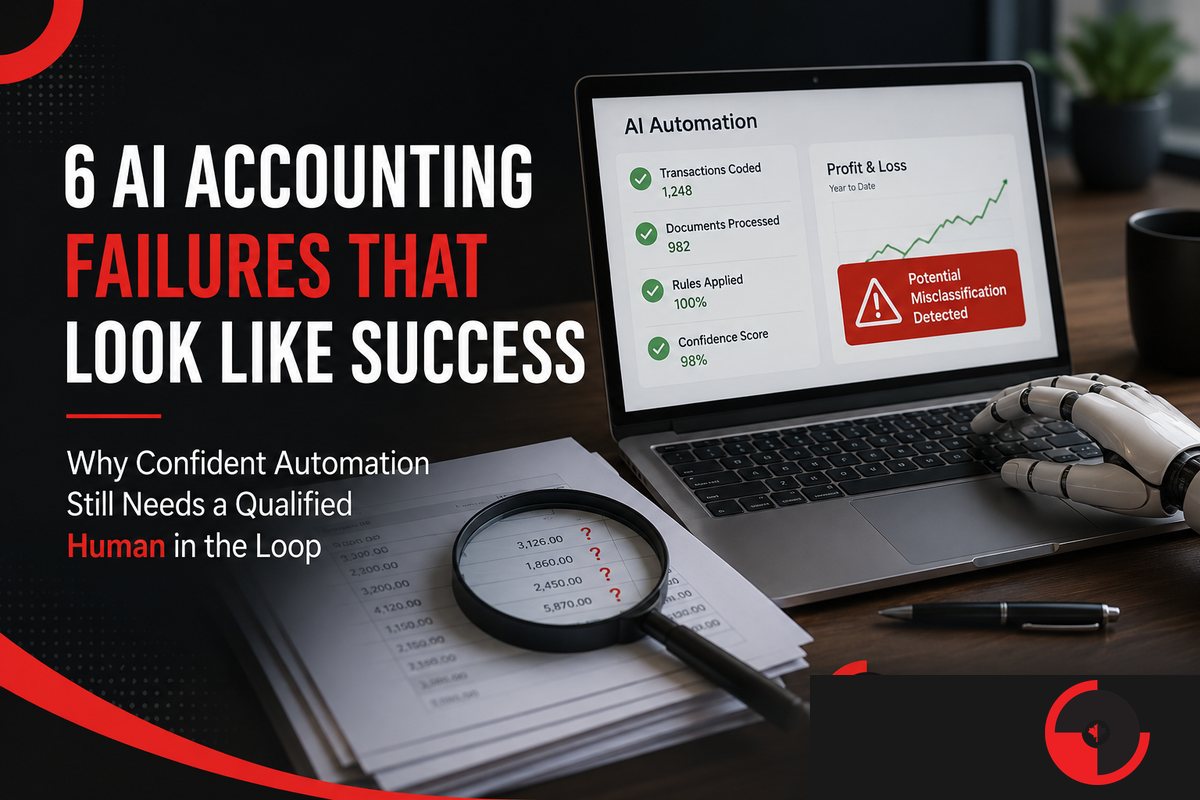
The problem with AI in accounting isn’t that it gets things wrong. It’s that it gets things wrong confidently, consistently, and in ways that look completely normal on the page.
A bookkeeper who doesn’t understand a transaction leaves it uncategorized, or asks. An automated system categorizes it — plausibly, immediately, and identically every month thereafter. One of those failure modes announces itself. The other compounds quietly for three quarters until someone notices the margin has drifted and can’t explain why.
We use AI tools daily and they’ve genuinely changed how our practice operates. This article isn’t an argument against them. It’s an honest account of where they fail, why those failures are hard to see, and what a qualified human is still doing in the loop — because if you’re being sold automation as a replacement for professional judgment, you’re being sold something that doesn’t exist yet.
Six AI Accounting Failures That Look Like Success
These aren’t hypothetical. Each is something we’ve found in books that arrived at our door already “automated.”
The common thread: none of these produce an error message. They produce a clean, balanced, professional-looking set of books that happens to be wrong in a specific place. That’s a fundamentally different risk profile from manual bookkeeping, and it requires a different kind of vigilance.
When did someone last review what your automation is doing?
Book a free 30-minute discovery call. We’ll look at how your books are actually being produced and tell you honestly where the review gaps are.
Where AI in Accounting Draws the Line: Pattern Recognition Versus Judgment
There’s a clean principle underneath all six AI accounting failures, and it’s worth stating plainly because it predicts where automation will work and where it won’t.
AI is excellent at questions whose answer is contained in the data. It fails at questions whose answer requires knowing something the data doesn’t record.
“Which account does this transaction resemble?” is answerable from the data. “Should this revenue be recognized this month or next?” depends on contract terms, performance obligations, and professional standards — none of which appear in a bank feed.
AI DOES THIS WELL
✓ Matching transactions to accounts
✓ Extracting data from documents
✓ Flagging anomalies against history
✓ Drafting first-pass variance commentary
✓ Recalculating models across scenarios
✓ Finding the needle in a large dataset
A HUMAN STILL DOES THIS
→ Deciding which period activity belongs to
→ Judging whether a credit is eligible
→ Knowing which facts aren’t in the system
→ Signing off on statements others rely on
→ Recognizing when the output is wrong
→ Being accountable when it is
That last item on the right isn’t a technical limitation — it’s a structural one. When a lender relies on your financial statements, someone has to stand behind them. A model cannot hold professional liability, cannot be a member of a professional body, and cannot be called to explain a position to the CRA. As long as accountability is part of what financial reporting means, a person is required.
The Skill AI in Accounting Hasn’t Replaced
Here’s the uncomfortable part for our profession: AI in accounting has genuinely automated a large share of what junior accounting work used to be. Data entry, transaction coding, document filing, first-pass reconciliation. That work isn’t coming back, and pretending otherwise doesn’t help anyone.
What it hasn’t automated is knowing when the output is wrong — and that skill turns out to be harder to acquire, not easier, in an automated environment.
Reviewing automated books is a different discipline from doing them. You’re not checking arithmetic; the arithmetic is right. You’re asking whether the classification reflects economic reality, whether anything is missing entirely, whether the pattern the system learned was correct in the first place. That requires understanding what the business actually does — which is context no system has.
It’s also why the review has to be done by someone senior. A junior reviewer checking automated work tends to confirm it, because the output looks like what they’d have produced. Catching a plausible-but-wrong classification requires knowing what right looks like in your specific business.
20 errors per 1,000 items
by any failure on this list
catches drift before it compounds
AI Accounting Without a Documented Process Is Worse Than None
This is the failure we see most often, and it’s the one most likely to affect you.
A business switches on bank feeds, categorization rules, and automated document capture — without ever having written down how the close is supposed to work, who reviews what, or what “correct” looks like for their specific accounts. The automation faithfully executes an undefined process at speed.
Manual processes have an accidental control built in: a human touches every transaction, so egregious errors sometimes get noticed. Remove that without replacing it with a deliberate review step and you’ve removed the only safety net you had.
The sequence that works is unglamorous: document the process first, establish who reviews what and when, then automate the steps that don’t require judgment. Doing it in the other order is how businesses end up with three quarters of confidently wrong books.
Automated books still need someone senior reviewing them
That’s what a fractional controller does — the review layer above your bookkeeper and above your software. No pressure, no obligation, just an honest assessment.
Questions Worth Asking Whoever Handles Your Books
Whether that’s an internal bookkeeper or an external firm, these four answers tell you where you stand.
The third question is the important one. If the honest answer is “at year-end, maybe,” you have a review gap rather than a technology problem — and the fix is a person, not a better tool.
Frequently Asked Questions
The Bottom Line
The case for a controller or CFO in the age of AI accounting isn’t that the technology doesn’t work. It’s that the technology works well enough to be trusted, and trusted systems need someone checking them.
- ✓If your books are automated and unreviewed: that’s the gap, and it’s a person-shaped one
- ✓If you automated before documenting: go back and document, then re-check the rules
- ✓If nobody senior looks at the output monthly: errors are compounding right now, silently
Use the tools. They’re good, and getting better. Just don’t confuse an output that looks right with one that is — that distinction is the entire job, and it’s the part that hasn’t been automated.
Good tools still need a qualified reviewer
Book a free 30-minute discovery call. We’ll look at how your books are actually produced, where the automation is running unsupervised, and what a proper review layer would catch.